Skip to content

indicator / indicators

Axiom MA

A three-slot moving-average overlay with a weighted blended line, honest multi-timeframe reads, and alerts gated to confirmed bars. Built for operators who pick their MA contexts on purpose and want to inspect every slot that shapes the blend.

Last updated: Jun 1, 2026

Crypto / Forex +4 / 1m / 5m +5

Free access

Free access

Read everything on this page first. Open it on TradingView only when you are clear on what it does and what it does not do.

Open in TradingView

You need a TradingView account for tools that open or run on TradingView.

These tools support analysis, testing, planning, and review. They do not make trading decisions for you.

Refund policy / Access help

Product details

Explore the details to see whether the tool fits the problem you are trying to solve for.

Overview

Most chart operators who work with moving averages already use more than one, and the hard part is not picking an MA — it is running several at once without the tool quietly deciding what the current bar means.

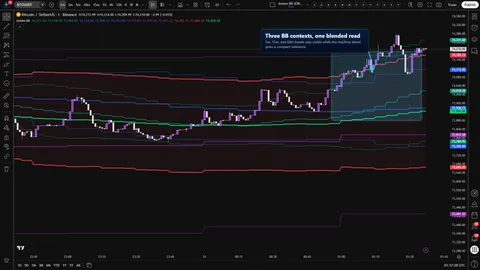
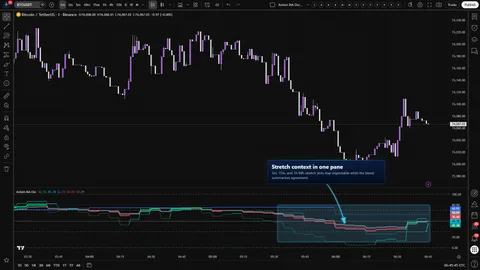
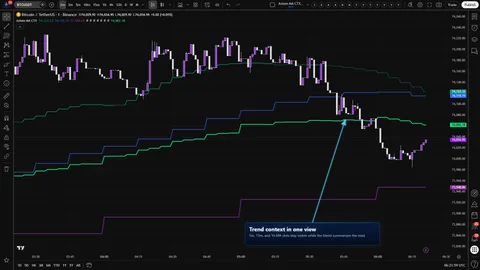
Axiom MA is three moving-average slots and one weighted blended line, drawn on the chart symbol's price space. Each slot carries its own source, higher timeframe, MA family, length, and trend lookback. Every enabled slot with a non-zero weight feeds the blend, with one library caveat worth naming: SWMA is fixed-length and does not use the Length input.

The trust boundary is one switch. On Bar Close? is a single global toggle that decides how every slot reads the higher timeframe — the confirmed previous close in one direction, the live developing value in the other. Alerts wait for the chart bar to confirm either way, so nothing fires mid-bar. And the blended line stays what it is: a weighted average of the slots you feed it, not a smarter moving average than the ones underneath.

Fit: an operator who picks three MA contexts on purpose, weighs them on purpose, and wants each one inspectable on its own. Misfit: anyone looking for a buy-or-sell line, a setup score, a fourth slot, a cross-symbol read, or per-family MA power-user controls.

Where this version sits

Axiom indicator families use a Base -> CTX -> STR progression when the full set exists. Base is the focused/free version: three chart-symbol slots, one global repaint posture, and the Lite MA surface. CTX expands that same MA read into ten slots with optional per-slot tickers, per-slot timing control, deeper Power User controls, and the Pro MA surface. STR sits after CTX where it exists: it keeps the stronger per-slot control pattern, reduces the stack to five slots because of the added computation, and spends that budget on structure around the blended output. This page covers Base, so reach for it when the three-slot chart-symbol read is enough.

Features

Three independent MA slots. Slot 01, slot 02, slot 03. Each slot configures its own timeframe, source, MA type, length, trend length, line width, and blended weight. Slot colors are fixed — teal, blue, purple — and the downtrend color runs at 50% transparency, so the trend state of each slot is visible without extra markers.

One weighted blended line. Enabled slots with non-zero weight combine into a single MA line. Its trend is decided by weighted majority of slot trends — lime when the weight leaning up is at or above the weight leaning down, red otherwise. The default line width is heavier than the slots by one step so the blend reads distinct from the lines that built it.

Hide the plot, keep the slot. A slot can be hidden from the chart while still computing and still contributing to the blend. Useful when a slot is present to steer the blend and does not need its own line on screen.

Weight out of the blend, keep on the chart. Weight zero keeps the slot drawn and removes it from the blend. Useful when a slot is a reference line rather than a vote.

One global On Bar Close? switch. One toggle for every slot's higher-timeframe read. Base does not expose a per-slot version of this control — that lives on CTX and STR.

Alert surface. Per-slot trend (six conditions), blended trend (two), and alignment across every enabled slot with a non-na MA value (two). Every condition is gated to the confirmed chart bar.

Hidden count plots. Two display.none series carry the active uptrend and active downtrend counts across enabled slots, so alerts and external tooling can reference those counts without adding anything to the chart.

How to use
  1. Add the indicator to a chart whose timeframe is at or below every slot timeframe in use. With the defaults, slot 01 is on 5m, so the chart has to be 5-minute or lower. A 1-minute or 5-minute chart is a safe first pick.
  2. Leave the three defaults: slot 01 on 5m, slot 02 on 15m, slot 03 on 60m. SMA 20, close as the source, trend length 3, blended weight 33.3 each, and the blended MA on.
  3. Confirm the three slot lines draw in their slot colors with a visible difference in smoothness, and that the blended line sits among them.
  4. If alerts are going to be wired up, leave On Bar Close? ON.

What correct first use looks like. Three stacked MAs in teal, blue, and purple. One heavier line, lime or red depending on the weighted majority. No runtime error while the settings are valid. Toggling On Bar Close? should change how the live last bar behaves; OFF is not a clean historical-replay posture.

If you set a slot's timeframe below the chart timeframe, the script stops with a named runtime error. That is intentional. Either lower the chart timeframe or raise the slot's.

Settings

High-impact first. Panel tooltips cover the full list.

  • Enable MA 0N. ON for all three slots by default. Turn a slot off when it duplicates another or when you are not actually willing to weigh that context.
  • Hide MA 0N Plot. OFF by default. Hide the line when a slot should steer the blend without adding another line to read. The slot still computes.
  • Source. close by default. Change it when a different source price is what the method actually wants read, not to tilt the stack without naming why.
  • TimeFrame. 5, 15, 60 for slots 01, 02, 03. Must be at or above the chart timeframe. A lower value raises a named runtime error when the script runs under that configuration and identifies the offending slot. This is a hard stop rather than a warning.
  • Length. 20 across all three slots. Longer usually smooths more and reacts later; shorter usually traces the source more closely. SWMA is the exception in the Lite library: it is fixed-length, so this input does not change that MA type's smoothing window.
  • Type. SMA by default. The available MA families come from the Axiom Moving Average Library Lite; Base does not expose per-family power-user controls.
  • Trend Length. 3 by default. Drives per-slot color and per-slot trend alerts. Shorter reacts faster; longer requires a more committed move before the slot is flagged as rising. Setting it to 0 disables the trend read for that slot, which reports as downtrend for alert and alignment purposes once its MA value is valid.
  • Line Width. 2 on slots, 3 on the blend.
  • Blended Weight. 33.3 each by default. Weights do not need to sum to 100; the blend divides by total weight present, so the scale is relative. Weight 0 keeps the slot drawn and pulls it cleanly out of the blend. The script does not enforce positive-only weights, so stay with zero-or-positive weights unless you are deliberately testing an edge case.
  • Blended MA — Enable, Hide Plot, Line Width. ON, OFF, 3. Hiding the blended line keeps it in alert logic.
  • On Bar Close? ON by default. Global. See Alerts and For the geeks for what each position means.

Common miss: leaving every weight at 33.3 and reading the default blend as a considered choice. It is a starting point, not an endorsement.

Alerts

Ten alertcondition entries. Every one is gated to the confirmed chart bar, so no alert fires mid-bar regardless of the on-bar-close switch.

  • Per-slot trend, six conditions. MA 01 Is Uptrend, MA 01 Is Downtrend, MA 02 Is Uptrend, MA 02 Is Downtrend, MA 03 Is Uptrend, MA 03 Is Downtrend.
  • Blended trend, two conditions. Blended MA Is Uptrend, Blended MA Is Downtrend.
  • Alignment, two conditions. All MA Slots Uptrend, All MA Slots Downtrend. Both require at least one enabled-and-valid slot.

These are level conditions, not edge events. Is Uptrend means the slot's MA is at or above its own value Trend Length bars ago, and the condition holds for as long as that stays true. TradingView's own alert-frequency setting decides firing cadence. For one alert per confirmed bar where the condition is true, set the TradingView alert to Once Per Bar Close.

What the alert surface is not. No close-versus-MA conditions. No slot-to-slot crosses. No pullback, no overextension, no edge-only "flipped this bar" events. If that shape is what the method needs, this trim is not the place to build it.

For the geeks

Two mechanics a careful reader deserves before calibrating trust.

Safe higher-timeframe reads with one global switch. The default Pine approach for multi-timeframe work can leak future values into the current bar, and blanket no-repaint claims in this corner of the market are often enforced weakly, if at all. Base collapses the choice into one switch the operator can see and verify. On Bar Close? ON: each slot reports the confirmed previous higher-timeframe bar's MA and trend — slower to react, but stable on confirmed history, with the most recent live chart bar lagging by one closed higher-timeframe bar. OFF: each slot reports the live higher-timeframe MA and trend — faster to react, but the value can move until that higher-timeframe bar closes, and historical/replay views should not be treated as the exact path a live bar took while forming. Alerts do not care which position the switch is in; they wait for the chart bar to confirm. To verify: flip the switch on a liquid symbol and watch the live last bar react sooner with OFF and settle with ON. Note that Base uses a single global switch; per-slot versions of this toggle live on CTX and STR.

The weighted blend and the weighted-majority trend read. The blend sums the MA values of enabled slots scaled by their weights, then divides by the total weight present, so the scale is relative and weights do not need to total 100. The blend's own trend is read by weighted majority: the total weight behind uptrend slots versus the total weight behind downtrend slots. A tie reads as uptrend because the comparison is inclusive. This is useful when you want a single anchor line and still want to inspect the inputs that drew it — it is not a second-order reading. A slot pointed at the wrong timeframe with a heavy weight will drag the blend, and the chart will not warn you; the only way to catch that is to know which slots are steering the blend and why. To verify: disable two slots, set the third's weight to 10, and confirm the blend tracks that slot; then re-enable a second slot with a larger weight and watch the blend shift toward the heavier slot.

FAQ

How does On Bar Close? actually work, and does this repaint?

It is the single switch that decides how every slot reads the higher timeframe. ON returns the confirmed previous higher-timeframe bar's MA and trend — stable on confirmed history, with the live chart bar lagging by one closed higher-timeframe bar. OFF returns the live higher-timeframe values, which can move until that higher-timeframe bar closes. Alerts are gated to the confirmed chart bar regardless, so nothing fires mid-bar. The real question is which behavior the operator wants out of the most recent live bar, and whether every alert wired up to this chart assumes the same answer.

Why didn't one of my MAs show up?

Almost always because a slot's timeframe is set below the chart timeframe. The script raises a runtime error under that configuration and names the offending slot. Either raise that slot's timeframe or move the chart to a lower one.

Is the blended line a smarter moving average?

No. It is a weighted average of the enabled slots, and its trend is a weighted majority of those slots' trends. It inherits whatever the slots are fed. A slot you misconfigured and gave a heavy weight will pull the blend without a chart warning. Read the blend as a compact summary of the slots under it, not as a second-order reading of the market.

Can I alert on price crossing an MA, or on one MA crossing another?

No. The alert surface on this trim covers per-slot trend, blended trend, and alignment across enabled slots whose MA values are non-na. There are no close-versus-MA conditions, no slot-to-slot crosses, and no edge-only flip events. If crosses are part of the method, this trim will not carry that weight on its own.

Do I need CTX or STR if I already use Base?

Probably not, unless the method specifically asks for another version's surface. CTX opens ten slots, optional cross-symbol reads, per-family Power User parameters for MA types like ALMA and KAMA, and a per-slot on-bar-close toggle. STR sits after CTX where it exists and adds structure around the blended output while carrying fewer slots. If those controls are not already part of how the operator reads MAs, Base is the more honest stopping point.

Limitations
  • The indicator does not generate signals, score setups, or predict direction. It plots moving-average context.
  • The blend inherits the quality of the slots feeding it. A misweighted slot can drag it without a visual warning.
  • Three slots is the ceiling on this trim. Cross-symbol reads and per-family MA power-user controls are not exposed here.
  • The alert surface is intentionally narrow: per-slot trend, blended trend, and alignment across enabled slots whose MA values are non-na. No slot crosses, no close-versus-MA alerts, no edge-only flip events.
  • Slot timeframes must be at or above the chart timeframe. A lower value raises a named runtime error when the script runs under that configuration.
  • Setting a slot's Trend Length to 0 disables its trend read, and that slot is then treated as downtrend for alert and alignment purposes once its MA value is valid.
  • If the blend is enabled while no enabled slot has a usable positive voting-weight setup, the current source can still leave the blended plot at its default 0/down state. Treat that as a configuration problem, not a market read.
Support and training

Support and documentation live on the AxiomCharts website. Reach us through the contact channel there.

Disclaimer

Axiom MA is an analysis and charting tool. It is not investment advice, not a recommendation, and not a trading system. Markets carry risk, including the loss of capital. You are responsible for your own decisions, your own risk sizing, and your own verification of any setup built on top of this indicator. Past behavior of any chart, market, or configuration does not determine future behavior.

Related products

If this one is close but not quite right, there may be a better fit nearby for the same kind of chart work, testing need, or workflow gap.

Back to products
Axiom MA CTXindicator
Axiom MA CTX thumbnail

indicator / indicators

Axiom MA CTX

A ten-slot moving-average workbench with a weighted blended line, safe multi-timeframe reads, and optional cross-symbol studies. Built for operators who want to stack MA context without losing the ability to inspect each slot.

1m5m15m1H4H1DANY

Crypto / Forex +4 / 1m / 5m +5

Axiom BBindicator
Axiom BB thumbnail

indicator / indicators

Axiom BB

Free

Three Bollinger Band slots and one weighted blended band on a single overlay. Built for operators who want a small, honest BB stack across timeframes without giving up control over confirmed-versus-live higher-timeframe reads.

1m5m15m1H4H1DANY

Crypto / Forex +4 / 1m / 5m +5

Axiom MA Oscindicator
Axiom MA Osc thumbnail

indicator / indicators

Axiom MA Osc

Free

A three-slot MA-stretch oscillator with bounded 0..100 slot reads, a weighted composite, and an optional post-blend smoothing pass. The focused/free Base version for operators who want a small-surface MTF stretch read.

1m5m15m1H4H1DANY

Crypto / Forex +4 / 1m / 5m +5

Weighing a few options against each other?

Tell us what you are trying to accomplish and we will help you narrow it down honestly.