Skip to content

indicator / indicators

Axiom BB

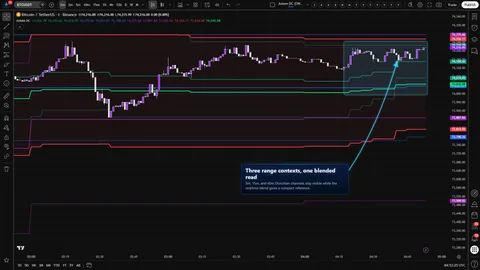
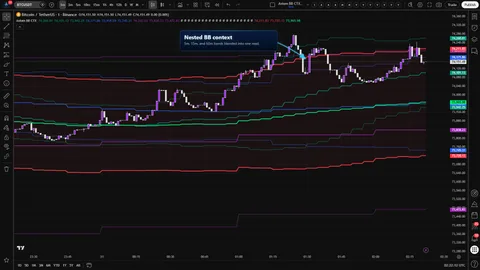
Three Bollinger Band slots and one weighted blended band on a single overlay. Built for operators who want a small, honest BB stack across timeframes without giving up control over confirmed-versus-live higher-timeframe reads.

Last updated: Jun 1, 2026

Crypto / Forex +4 / 1m / 5m +5

Free access

Free access

Read everything on this page first. Open it on TradingView only when you are clear on what it does and what it does not do.

Open in TradingView

You need a TradingView account for tools that open or run on TradingView.

These tools support analysis, testing, planning, and review. They do not make trading decisions for you.

Refund policy / Access help

Product details

Explore the details to see whether the tool fits the problem you are trying to solve for.

Overview

The real decision in a multi-timeframe Bollinger stack is not which three contexts to draw. It is whether the higher-timeframe read stays honest while the live bar is still moving, and whether the combined line represents what the operator actually chose — not what the tool quietly averaged on their behalf.

Axiom BB puts three independent BB slots and one weighted blended band on the same overlay, in the chart symbol's price space. Each slot carries its own timeframe, source, basis MA, length, and deviation, and any slot can be excluded from the blend without being removed from the chart.

Three things set the trust boundary. A single global On Bar Close? switch governs the higher-timeframe read for every slot at once — previous confirmed bar, or live developing bar. Alerts wait for the chart bar to confirm before firing, no matter where that switch sits. The blended band is a weighted average of whatever the operator feeds it; it is not a smarter Bollinger Band, and a heavily weighted slot pointed somewhere wrong will drag the blend without warning.

Fit is narrow on purpose — an operator who already reads BB context in their own method and wants three slots and a blend on one chart without losing inspection of any of them. It is the wrong tool for anyone hunting a buy/sell line, a setup score, or "the right" BB settings. None of those live here.

Where this version sits

Axiom indicator families use a Base -> CTX -> STR progression when the full set exists. Base is the focused/free version: three chart-symbol slots, one global repaint posture, and the Lite MA surface. CTX expands that same Bollinger Band read into ten slots with optional per-slot tickers, per-slot timing control, deeper Power User controls, and the Pro MA surface. STR sits after CTX where it exists: it keeps the stronger per-slot control pattern, reduces the stack to five slots because of the added computation, and spends that budget on structure around the blended output. This page covers Base, so reach for it when the three-slot chart-symbol read is enough.

Features

The three-slot set

  • Three independent BB slots, each with its own timeframe, source, basis MA family, length, deviation, basis trend lookback, line width, and blended weight.
  • Fixed slot colors — teal for slot 01, blue for 02, purple for 03 — so identity stays stable when the panel gets reorganized.
  • Enable BB 0N turns a slot on or off. Hide BB 0N Plot suppresses the drawing while keeping the slot active in the blend, so a slot can steer the blended read without adding another line to the chart.

The blended band

  • One weighted band built from the enabled slots: red upper, faint red fill, red lower, lime basis.
  • Weights do not have to sum to anything specific; the blend divides by the weight actually present. A slot with weight 0 stays drawn but is excluded from the blend. Keep at least one enabled slot carrying a positive total weight if you want a meaningful composite; the script does not stop you from creating a zero-weight or negative-total-weight edge case.
  • The blended basis trend is decided by a weighted majority of the slot trend reads.

Safe multi-timeframe reads

  • Slot data is requested through the documented safe-MTF pattern.
  • One global On Bar Close? switch governs every slot's higher-timeframe read at once. ON returns the previous confirmed higher-timeframe bar's BB; OFF returns the live higher-timeframe bar.
  • A slot timeframe set below the chart timeframe stops the script with a named runtime error rather than quietly returning misleading values.

Alert surface

  • Per-slot basis trend (uptrend / downtrend) for each of the three slots.
  • Blended basis trend (uptrend / downtrend).
  • Alignment across all enabled slots (all uptrend / all downtrend).
  • Every alert is gated to a confirmed chart bar.
How to use
  1. Add the indicator to a chart whose timeframe is at or below every slot timeframe in use. The defaults assume at least a 5-minute chart, so a 1-minute or 5-minute base is a safe first pick.
  2. Leave the three default-enabled slots (5m / 15m / 60m at length 20, deviation 2.0, SMA on close), the blended band on, and On Bar Close? ON.
  3. Confirm the three slot bands render in teal, blue, and purple, and that the blended band draws a single red upper and lower with a lime basis sitting between them.
  4. Only then start changing one thing — a slot timeframe, a source, a weight — and watch what each change does to the blend before the next change.

If alerts are going to be wired up, leave On Bar Close? ON. The toggle's OFF position is for watching the live higher-timeframe bar develop, not for firing on it.

Settings

Settings repeat per slot in the order they appear in the panel.

  • Enable BB 0N. Default ON for all three. Turn a slot off when it duplicates another or carries a context the operator does not actually want to weigh. Three of the same context is not three contexts.
  • Hide BB 0N Plot. Default OFF. Useful when a slot should count in the blend but should not crowd the chart.
  • Source. Default close. Anything Pine offers is available. Mixing sources across slots is a deliberate choice; mixing them by accident is the cleanest way to confuse a read.
  • TimeFrame. Defaults 5, 15, 60. Must be at or above the chart timeframe. If a slot is set below, the script raises a runtime error that names the offending slot. That is by design; a lower-timeframe pull from a higher-timeframe chart returns misleading values.
  • Length. Default 20. Classical Bollinger lookback. It drives the standard deviation calculation and the basis length for the Lite MA types that accept a length. SWMA is the exception in the imported Lite library; it uses Pine's fixed SWMA basis while Length: still drives the band deviation window.
  • StdDev Mult. Default 2.0. Higher widens the bands; lower tightens them. There is no universally correct value, and chasing one is a fine way to overfit a chart.
  • Type (basis MA). Default SMA. The imported Axiom MA Library Lite exposes SMA, EMA, RMA, WMA, VWMA, and SWMA. This trim does not expose per-family Power User controls; those live on CTX and STR.
  • Basis Trend Length. Default 3. Shorter reacts sooner to the basis turning; longer waits for a more committed move. Per-slot trend alerts, the all-slot alignment alert, and the blend's trend read all read from this.
  • Line Width. Default 2 per slot, 3 for the blended band.
  • Blended Weight. Default 33.3 for each slot. Weights are relative; the blend divides by what is actually present. A weight of 0 keeps the slot drawn and removes it from the blend. Leaving every slot at the default and assuming the blend reflects intent is the easiest way to end up with a line nobody actually chose.
  • Blended BB — Enable / Hide Plot / Line Width. Default ON / OFF / 3. Hiding the blended band hides the upper, lower, basis, and the fill between upper and lower together.
  • On Bar Close? Default ON. Global. Governs the higher-timeframe read for every slot at once. See Alerts and For the geeks.
Alerts

Every published alert is gated by barstate.isconfirmed. An alert cannot fire until the chart bar has confirmed closed, regardless of the global on-bar-close switch.

  • Per slot (01–03). BB 0N Basis Is Uptrend and BB 0N Basis Is Downtrend. Trend is the slot's basis compared to its value Basis Trend Length bars ago.
  • Blended band. Blended BB Basis Is Uptrend and Blended BB Basis Is Downtrend. These run off the blended basis trend produced by the weighted-majority rule.
  • Alignment. All BB Slot Bases Uptrend and All BB Slot Bases Downtrend. These fire when every currently enabled slot agrees.

Alert text references {{ticker}} and {{interval}}.

There are no band-touch, band-cross, reversion, squeeze, close-vs-basis, or close-vs-band alerts. The surface is intentionally narrow — direction and alignment only. Anything more specific can be built on top of the slot plots downstream.

For the geeks

Two parts of this trim behave differently enough from a textbook MTF BB that they are worth naming in plain language.

Safe MTF and the single global on-bar-close switch. Higher-timeframe data is pulled using the MTF alignment pattern TradingView documents. The global On Bar Close? toggle decides which higher-timeframe bar each slot returns. ON returns the previous confirmed higher-timeframe bar's BB values — slower to update, stable on confirmed history, lagging the live candle by one closed higher-timeframe bar. OFF returns the live higher-timeframe values and can repaint until that bar closes. Alerts are gated to confirmed chart bars either way. The choice is global on this trim; per-slot timing control lives on CTX and STR, not here. Verify it by adding the indicator to a 1-minute chart, flipping the toggle, and watching the most recent live bar move sooner with the toggle OFF and settle once the higher-timeframe bar closes. Confirmed history should not move in either case.

The weighted blend and its trend read. The blended band averages the upper, basis, and lower of every enabled slot carrying a nonzero weight when those weights produce a positive total. The blended basis trend comes from a weighted majority of the slot trend flags, with a tie reading as uptrend. The blend has no opinion about which slot deserves more weight — it inherits whatever it is fed, and a misconfigured slot with a heavy weight will drag the blend with no visible warning. If the contributing weights sum to zero or less, the script falls back to zero values rather than inventing a useful composite. Verify the normal case by disabling two slots, setting the third's weight to a positive number, and confirming the blended band tracks that slot. Then re-enable a second slot at a heavier positive weight and confirm the blend shifts toward the heavier one.

No formulas, no thresholds, no pseudocode. Mental model only — the rest is in the source, where it belongs for any operator who wants to read it.

FAQ

Does this repaint? The global On Bar Close? switch decides. ON returns the previous confirmed higher-timeframe bar's values, which will not repaint. OFF returns the live higher-timeframe bar and can repaint until that bar closes. Alerts are bar-close gated either way, so even on OFF an alert cannot fire mid chart bar. If alerts matter, stay ON.

One of my slots didn't show up — what happened? Its timeframe is most likely below the chart timeframe. The script raises a named runtime error in that case because pulling a lower-timeframe value into a higher-timeframe chart returns misleading output. Raise the slot's timeframe, or drop the chart timeframe.

Is the blended band a smarter Bollinger Band? No. It is a weighted average of the slots that are enabled at the weights they were given. It inherits the quality of those choices, including the bad ones. Treat it as a compact reference while the underlying slots are still on the chart for inspection.

Can I alert on band touches or band crossings? Not from this indicator. The published alerts cover per-slot basis trend, the blended basis trend, and alignment across all enabled slots. Touch, cross, squeeze, and reversion logic are not part of the surface and would have to be built downstream from the slot plots.

Do I need CTX or STR if I already use this one? Probably not, unless the actual work calls for another version's surface. CTX opens ten slots with cross-symbol pulls, per-slot timing, and per-family MA controls. STR sits after CTX where it exists and adds structure around the blended output while carrying fewer slots. If three slots, a single symbol, and a global timing switch are doing the job, Base is the right version.

Limitations
  • The indicator does not generate trade signals, does not predict direction, and does not score setup quality. Those judgments stay with the operator.
  • The blend is a weighted average. It has no view about which slot deserves the weight and will mirror a misweighted slot's read when one carries the bulk of the total.
  • The trim runs on a single symbol — the chart symbol. Cross-symbol studies live on CTX and STR.
  • The MA selector exposes the Lite library. Per-family Power User controls live on CTX and STR and are not available here.
  • The alert surface is narrow on purpose: per-slot trend, blended trend, all-slot alignment. No band-touch, band-cross, squeeze, or reversion alerts are published.
  • A slot timeframe set below the chart timeframe is a hard stop, not a warning. The script refuses to draw until the configuration is corrected.
Support and training

Documentation and support live at axiomcharts.com. Any channel not linked from there is not an official one.

Disclaimer

This indicator is an analytical tool for charting context. It is not investment advice and is not a recommendation to buy, sell, or hold any instrument. Markets can move against any read the tool produces. The operator is responsible for their own trade decisions, their own risk management, and their own verification of anything the tool displays.

Related products

If this one is close but not quite right, there may be a better fit nearby for the same kind of chart work, testing need, or workflow gap.

Back to products
Axiom BB CTXindicator
Axiom BB CTX thumbnail

indicator / indicators

Axiom BB CTX

A ten-slot Bollinger Band workbench with a weighted blended band, safe multi-timeframe reads, and optional cross-symbol studies. Built for operators who want to stack context without giving up the ability to inspect each slot.

1m5m15m1H4H1DANY

Crypto / Forex +4 / 1m / 5m +5

Axiom DCindicator
Axiom DC thumbnail

indicator / indicators

Axiom DC

Free

A three-slot multi-timeframe Donchian Channel overlay with a weighted combined channel. For operators who already read Donchian structure and want a chart-side read stacked with two higher-timeframe reads on the same chart.

1m5m15m1H4H1DANY

Crypto / Forex +4 / 1m / 5m +5

Axiom MAindicator
Axiom MA thumbnail

indicator / indicators

Axiom MA

Free

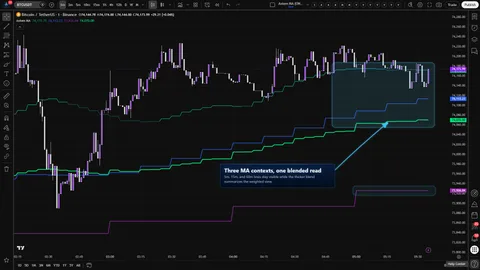
A three-slot moving-average overlay with a weighted blended line, honest multi-timeframe reads, and alerts gated to confirmed bars. Built for operators who pick their MA contexts on purpose and want to inspect every slot that shapes the blend.

1m5m15m1H4H1DANY

Crypto / Forex +4 / 1m / 5m +5

Weighing a few options against each other?

Tell us what you are trying to accomplish and we will help you narrow it down honestly.