Skip to content

indicator / indicators

Axiom MA Osc

A three-slot MA-stretch oscillator with bounded 0..100 slot reads, a weighted composite, and an optional post-blend smoothing pass. The focused/free Base version for operators who want a small-surface MTF stretch read.

Last updated: Jun 1, 2026

Crypto / Forex +4 / 1m / 5m +5

Free access

Free access

Read everything on this page first. Open it on TradingView only when you are clear on what it does and what it does not do.

Open in TradingView

You need a TradingView account for tools that open or run on TradingView.

These tools support analysis, testing, planning, and review. They do not make trading decisions for you.

Refund policy / Access help

Product details

Explore the details to see whether the tool fits the problem you are trying to solve for.

Overview

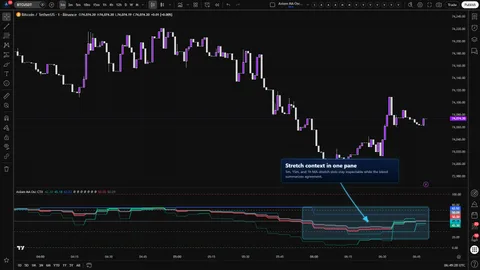
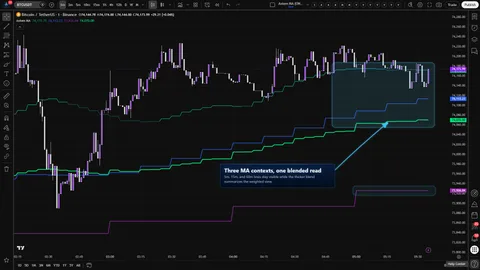
You want a read on how far price has pulled from a moving-average structure you already trust, across two or three higher timeframes, without stacking three separate indicators to get there. Axiom MA Osc runs up to three independent MA-stretch slots in a single pane. Each slot picks its own higher timeframe, its own baseline MA family and length, and its own slow-line MA family and length. Each slot measures price distance from its baseline in ATR units and compresses that distance into a bounded 0..100 view. Enabled slots combine into one weighted Fast-and-Slow pair, with an optional post-blend smoothing pass when you want the composite calmer.

The 0..100 scale is a bounding — not a probability, not a reversion score, not a calibrated gauge. Repaint is governed by one global On Bar Close? switch that applies to every slot on this trim. Alerts fire only on confirmed chart bars regardless of where that switch is set.

Fit. Operators who already read moving averages as structure and want a small-surface MTF stretch read across two or three higher timeframes.

Misfit. Anyone looking for a buy-or-sell call, a pre-curated "best settings" bundle, or a calibrated reversion signal. This tool reports state; it does not decide.

Where this version sits

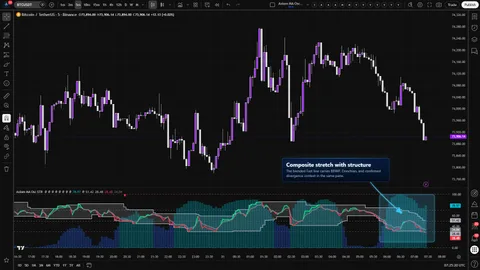
Axiom indicator families use a Base -> CTX -> STR progression when the full set exists. Base is the focused/free version: three chart-symbol slots, one global repaint posture, and the Lite MA/filter surface. CTX expands that same MA-stretch logic into ten slots with optional per-slot tickers, per-slot timing control, deeper Power User controls, and the Pro MA/filter surface. STR sits after CTX: it keeps the stronger per-slot control pattern, reduces the stack to five slots because of the added computation, and spends that budget on divergence, Keltner, BBWP, and Donchian structure around the blended Fast line. This page covers Base, so reach for it when the three-slot chart-symbol stretch read is enough.

Features

The three-slot stack. Three enable-able slots, each with its own source, timeframe, baseline MA family and length, slow-line MA family and length, line width, and blended weight. Any slot can be enabled without being drawn (useful when you want it to steer the composite without crowding the pane) or drawn without steering the composite (set its blended weight to zero).

ATR-normalized stretch. Each slot measures the distance between its source and its baseline MA in ATR units, then compresses that distance into a bounded 0..100 read. Two shared knobs shape the mapping: ATR Length controls how far back the ATR reference reaches, and ATR Sensitivity scales the distance before it is bounded. Because the bounding is shared across slots, the reads sit on one pane without one timeframe automatically swamping the others.

Fast and Slow per slot. Fast is the bounded stretch read. Slow is a smoothing of Fast on an independently chosen MA family — used for state classification and for alerts. When Fast is above Slow, the slot is in a bullish Fast-vs-Slow state; when below, bearish. That is what the per-slot alerts report.

Bounded pane with fixed references. Hard lines at 0 and 100 bound the view; the 30, 50, and 70 lines are visual reference guides. The 30 and 70 levels are operator-adjustable in the inputs, but nothing in the indicator acts on them — they are visual context, not thresholds the tool fires off.

Weighted blend of the enabled slots. Blended Fast and Blended Slow are a weighted average of the enabled slot reads that have a non-zero blended weight and a non-na Fast value. Weights do not need to sum to 100; the blend divides by the total of the weights it actually used. A slot with weight zero is excluded from the blend but still drawn when enabled.

Optional Master Smoothing. One additional MA pass can be applied to Blended Fast and Blended Slow, then re-clamped to 0..100. It trades responsiveness for calm by design. It does not improve the data going in.

Alert surface. Ten conditions in total, all gated to confirmed bars. Per-slot bullish and bearish for slots 01, 02, and 03. Blended bullish and bearish. All-enabled-slots bullish and bearish when every enabled slot agrees with its own Slow line.

Moving-average families via the Axiom MA Lite library. Baseline, slow-line, and Master Smoothing MAs are all drawn from the same versioned library import. The families available on this trim are the Lite-library surface; CTX reaches for the Pro library to cover its wider surface.

How to use
  1. Add the indicator to a chart whose timeframe is at or below every slot timeframe you plan to use.
  2. Keep the defaults on first pass — three enabled slots at 5m, 15m, and 1h, EMA length 20 baseline with EMA length 3 slow, equal 33.3 weights. Leave Plot Blended Fast/Slow on.
  3. Confirm the shape of a correct first read. Three slot Fast lines (teal, aqua, blue) should stay inside the 0..100 band. Each line should draw brighter when its own Fast is above its own Slow and dimmed when below. Blended Fast should draw in lime when above Blended Slow and red when below, with a matching fill between them.
  4. If you plan to route alerts off this indicator, keep On Bar Close? on. That makes each slot read the previous higher-timeframe bar's values, which do not move once the bar is closed.

Two behaviors to expect the first time:

  • Setting a slot's TimeFrame: below the chart timeframe does not silently misbehave — the indicator raises a named runtime.error that identifies which slot is misconfigured. Fix the slot and recompile.
  • Hiding a slot (Hide MA 0N Plot) keeps the slot running and keeps it in the blend as long as its weight is non-zero. Hidden is not disabled.
Settings

The slot inputs appear in user-facing order for each of the three slots.

  • Enable MA 0N — turns the slot on or off. Disabling a slot drops it from the pane and from the blend in the same pass.
  • Hide MA 0N Plot — removes the Fast-line plot from the pane without touching the slot's contribution to the blend.
  • Source: — the price series the slot reads from. Default close.
  • TimeFrame: — the higher timeframe the slot is read at. Must be at or above the chart timeframe; otherwise the indicator raises a named runtime error. Leaving this field blank makes the slot inherit the chart timeframe, which is rarely what you want on a multi-timeframe tool.
  • Length: — the baseline MA lookback. Default 20.
  • Type: — the baseline MA family. Default EMA. Change this when you want the baseline to lead or lag differently; leave it alone until you have a reason.
  • Slow Length: — smoothing length for the Slow line. Default 3. Higher values give you a calmer Slow and slower state flips.
  • Slow Type: — the Slow-line MA family. Default EMA. Chosen independently from the baseline family.
  • Line Width: — visual only. Default 2.
  • Blended Weight: — the slot's weight in the composite. Default 33.3 across all three slots. Zero excludes the slot from the blend without removing it from the pane.

Shared settings that apply to every slot or to the composite:

  • ATR Length — lookback for the ATR reference used in the stretch measurement. Default 14. Higher is steadier.
  • ATR Sensitivity — scales the ATR distance before it is bounded. Default 1.0. Higher pushes more of the distribution toward 0 and 100; lower keeps more of it around the midline. Pushing this to an extreme flattens the slot reads at the bounds and is not a sharper signal.
  • Overbought Level / Oversold Level — the adjustable 70 and 30 reference lines. Visual only.
  • Plot Blended Fast/Slow and Blended Line Width: — display controls for the composite.
  • Enable Master Smoothing, Master MA Type, Master Length — the optional post-blend MA pass, off by default. Turning it on adds lag; that is the trade.
  • On Bar Close? — the single global repaint switch on this trim. ON returns each slot's previous higher-timeframe bar's Fast and Slow; OFF returns the live higher-timeframe bar's values and can shift until that higher-timeframe bar closes.
Alerts

All alert conditions fire only on confirmed chart bars. Alert messages reference {{ticker}} and {{interval}}.

  • Per-slot Fast-vs-Slow state (six conditions): MA Osc 01 Is Bullish / MA Osc 01 Is Bearish, and the same pattern for slots 02 and 03. A slot is bullish when its own Fast is above its own Slow.
  • Blended Fast-vs-Slow state (two conditions): Blended MA Osc Is Bullish and Blended MA Osc Is Bearish.
  • All-enabled-slots alignment (two conditions): All MA Osc Slots Bullish and All MA Osc Slots Bearish — fire when every enabled slot with a valid Fast is on the same side of its own Slow.

What is not in this alert surface: no alerts on crossing the 30 or 70 reference lines, no cross-above / cross-below event alerts, no slot-state-change alerts. The conditions report state; they fire while the state holds on a confirmed bar.

For the geeks

Four mechanics change what a serious operator should trust. Each is described at mental-model level — enough to calibrate trust, not enough to reconstruct the implementation.

ATR-normalized distance inside a bounded sigmoid. Each slot takes the distance between its source and its baseline MA, divides it by ATR to remove the instrument's own raw price scale, scales the result with ATR Sensitivity, and feeds that into a sigmoid compressed into 0..100. The bounding makes different slot reads easier to compare in one pane. What it gives up is magnitude at the extremes — a read of 99 versus 95 is not a calibrated distance, and different volatility regimes still deserve caution. If you want magnitude, read the Fast-vs-Slow gap and the distance of Fast from 50. Verify by sweeping ATR Sensitivity across its range; Fast should reshape without leaving the band.

Per-slot Fast and Slow on independently chosen MA families. Fast is the bounded stretch read. Slow is a smoothing of Fast, re-clamped to 0..100. Because the baseline MA and the slow-line MA are chosen independently, you can tune stability and responsiveness as separate decisions. To confirm, change only the slow-line family at the same length — the slot's state transitions should shift while Fast stays inside 0..100.

Safe MTF plus a global On Bar Close? toggle. The indicator reads each slot through request.security on the slot's higher timeframe. One global switch decides whether the call returns the previous higher-timeframe bar's Fast-and-Slow (stable once that HTF bar is closed) or the live higher-timeframe bar's Fast-and-Slow (faster, can move until that bar closes). Alerts are gated to confirmed chart bars independently, so an alert does not fire mid-chart-bar regardless of the toggle. On this trim the scope is global; per-slot repaint governance lives on CTX and STR. Flip the toggle to check the tradeoff directly: ON and OFF are different timing modes, not two ways to get the same historical line.

Weighted blend and optional post-blend smoothing. Blended Fast and Blended Slow are a weighted average of the enabled slot reads that have a non-zero weight and a non-na Fast. The composite inherits whatever its inputs carry — calibration, miscalibration, and timing exposure. When Master Smoothing is on, one more MA pass is applied and the result is re-clamped to 0..100; that trades responsiveness for calm by design. Zero two slot weights and the blend should track the remaining slot; re-weight and the composite drifts toward the slot you just re-weighted.

FAQ

How does repaint actually work here, and what should I do about alerts? Repaint is governed by a single global On Bar Close? switch. ON reads each slot off the previous higher-timeframe bar's values, which are stable once that bar is closed. OFF reads the live higher-timeframe bar's values, which can still shift until that bar closes. Alerts are separately gated to confirmed chart bars, so alerts will not fire mid-chart-bar either way. If you are routing alerts off this indicator, keep On Bar Close? on unless you have a reason not to.

A slot just threw a runtime error. What happened? The slot's TimeFrame: is set below your chart timeframe. The indicator raises a named runtime.error rather than returning a silent misread, and the error message identifies which slot is misconfigured. Set the slot's timeframe to your chart timeframe or higher and the error clears.

Is the blended line a smarter oscillator than the three slots? No. It is a weighted average of whichever enabled slots have a non-zero weight and a valid Fast value. It inherits the quality of whatever is feeding it. If one slot is miscalibrated — wrong baseline family for the instrument, a timeframe that does not fit the read you are after, an extreme sensitivity — the composite carries that miscalibration at full weight. The per-slot alerts exist partly so you can see what is making the composite look the way it does.

Is a reading near 100 a reversion signal? No. The 0..100 scale bounds the view; it does not calibrate the outcome. The bounding is there to keep slot reads legible in one pane without drifting out of frame. A read near 100 tells you the slot is currently showing a lot of ATR-distance from its baseline. What that means for price next is your call.

Base, CTX, or STR — which trim do I actually want? Base when three timeframes is enough and you want the smallest surface that still answers "is stretch building or fading across the timeframes I watch." CTX when you need ten-slot context breadth, per-slot repaint governance, and per-slot symbol overrides. STR when you want structure context added to the blended Fast line and can trade CTX's ten slots down to five for that extra computation.

Limitations
  • This is a state-reporting tool, not a signal generator. It reports per-slot and blended Fast-vs-Slow state. Direction, timing, and sizing remain operator decisions.
  • The 0..100 view is bounded by design. It is not a probability, a score, or a reversion gauge.
  • ATR-normalization does not remove regime shifts. On instruments with step-change volatility, slot reads can sit near a pane edge for extended stretches; that is the normalization doing its job, not a failure mode.
  • Master Smoothing adds lag by design. It does not improve the underlying data.
  • The Base trim runs all three slots on the chart symbol. Cross-symbol slot assignments are a CTX and STR capability.
  • The alert surface is narrow by design — per-slot state, blended state, and all-slots-aligned. No 30 / 70 reference-line crosses, no slot-state-change events, no cross-above / cross-below alerts.
  • On Bar Close? is global on this trim. Per-slot repaint governance is a CTX and STR capability.
Support and training

Documentation, usage notes, and support requests live at the AxiomCharts website. That is the route we maintain and the one we answer from.

Disclaimer

This indicator is provided for analysis and research. It does not provide trade signals, forecasts, or personalized investment advice. Past chart behavior is not a guarantee of future results. Markets carry risk; position sizing, risk management, and the final decision stay with you.

Related products

If this one is close but not quite right, there may be a better fit nearby for the same kind of chart work, testing need, or workflow gap.

Back to products
Axiom MA Osc STRindicator
Axiom MA Osc STR thumbnail

indicator / indicators

Axiom MA Osc STR

A five-slot multi-timeframe MA-stretch oscillator with a weighted composite and optional structure context — divergence, Keltner, BBWP, and Donchian — all built on the composite itself. STR trades CTX's ten-slot breadth for blended-line structure.

1m5m15m1H4H1DANY

Crypto / Forex +4 / 1m / 5m +5

Axiom MA Osc CTXindicator
Axiom MA Osc CTX thumbnail

indicator / indicators

Axiom MA Osc CTX

A ten-slot MA-stretch oscillator with bounded 0..100 slot reads, a weighted composite, optional master smoothing, and optional per-slot cross-symbol studies. For operators who already read moving averages as structure and want to stack several legible stretch contexts without losing the ability to inspect each one.

1m5m15m1H4H1DANY

Crypto / Forex +4 / 1m / 5m +5

Axiom MAindicator
Axiom MA thumbnail

indicator / indicators

Axiom MA

Free

A three-slot moving-average overlay with a weighted blended line, honest multi-timeframe reads, and alerts gated to confirmed bars. Built for operators who pick their MA contexts on purpose and want to inspect every slot that shapes the blend.

1m5m15m1H4H1DANY

Crypto / Forex +4 / 1m / 5m +5

Weighing a few options against each other?

Tell us what you are trying to accomplish and we will help you narrow it down honestly.