Skip to content

indicator / indicators

Axiom Stoch Osc STR

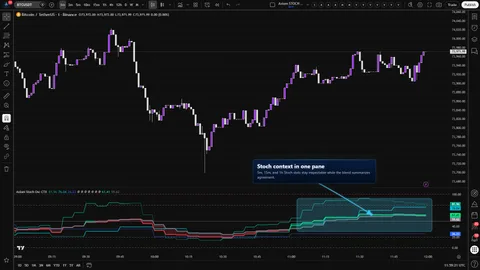
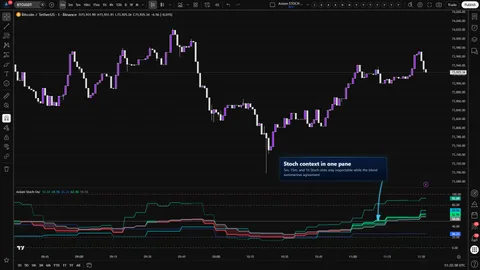
Five independent Stochastic slots, a weight-gated blend of the slot K and D lines, and pivot divergence, Keltner, BBWP, and Donchian context computed on the blended K — all inside Stoch's native 0..100 frame. STR trades CTX's ten-slot breadth for blended-line structure.

Last updated: Jun 1, 2026

Crypto / Forex +4 / 1m / 5m +5

Purchase options

Monthly / Yearly / One-time access

$3.00/ month

14-day free trial

You need a TradingView account for tools that open or run on TradingView.

These tools support analysis, testing, planning, and review. They do not make trading decisions for you.

14-day monthly trial / 14-day yearly trial / 30-day one-time refund window

Refund policy / Access help

Product details

Explore the details to see whether the tool fits the problem you are trying to solve for.

Overview

Axiom Stoch Osc STR is the expanded-structure trim of the Axiom Stoch oscillator. It is built for one reader: someone who already stacks Stoch across timeframes and wants structure around the blended K/D without leaving the 0..100 frame and without bolting unrelated tools onto chart price.

Stack Stoch across two or three timeframes, then add a divergence helper, an envelope, a width indicator, and a channel one at a time, and the pane stops describing the read you reached for. STR keeps that context on the blended K so the scaffolding stays legible as scaffolding and the oscillator keeps meaning what it normally means.

The question STR helps you answer is narrow and useful. Are your chosen Stoch timeframes actually agreeing, or just close? Is the blended K diverging from price on a confirmed pivot, or on a pivot that has not earned confirmation yet? Is the blended K compressing inside its own recent range, or stretching against it? STR reports on those three questions in the oscillator's own domain.

Two trust boundaries belong up front. Repaint behavior is a per-slot choice here, not a global property of the script — each slot owns its own bar-close switch, and each choice carries a cost you pick up consciously. The BBWP columns in this tool are computed on the blended K line, not on chart price; they will not match a price BBWP you have sitting elsewhere, and they are not trying to.

STR is the structure version, not a signal service. It adds context around your Stoch read. It does not replace the read, and it does not produce entries.

Good fit

  • Operators who already read multi-timeframe Stoch and want five slots plus optional structure context on the blended K.
  • Readers comfortable weighting slots deliberately and willing to price the repaint tradeoff per slot.
  • Readers who want divergence markers to sit on confirmed pivots rather than on a live guess.

Misfit

  • Readers looking for a buy/sell verdict, a calibrated momentum probability, or a best-settings bundle.
  • Readers who want a chart-price volatility tool. BBWP, Keltner, and Donchian here live on the blended K.
  • Readers unwilling to leave expansion features off when they are not adding something.
Where this version sits

Axiom indicator families use a Base -> CTX -> STR progression when the full set exists. Base is the focused/free version: three chart-symbol slots, one global repaint posture, and the smaller MA/filter surface where that family uses one. CTX expands that same Stochastic logic into ten slots with optional per-slot tickers, per-slot timing control, deeper Power User controls, and the broader MA/filter surface. STR sits after CTX: it keeps the stronger per-slot control pattern, reduces the stack to five slots because of the added computation, and spends that budget on divergence, Keltner, BBWP, and Donchian structure around the blended K line. Choose STR when blended-line structure matters more than CTX's ten-slot context breadth.

Features
  • Up to five Stochastic slots, each independent. Every slot gets its own source, K length, K-smoothing length and MA family, D-smoothing length and MA family, timeframe, optional symbol override, blend weight, and line width. Enable or hide them one at a time.
  • Weight-gated blended K and D. The blend is a weighted average across the active slots, clamped to 0..100. Zero-weight slots stay visible as plots without steering the blend. If every active weight resolves to zero or na, the blend returns nothing rather than guessing.
  • Standard stochastic axis, unchanged. Solid 50 midline, dashed overbought and oversold guides at your chosen levels (defaults 80 and 20), solid 0 and 100 boundaries. Fill between blended K and D colors by which line is on top.
  • Pivot-confirmed divergence. Bullish and bearish triangle markers compare chart-price pivots to blended-K pivots at the same symmetric lookback. Markers print only on confirmed pivots. Placement is configurable.
  • Keltner envelope on the blended K. Basis, bands, fill, and MA family are all configurable. Outputs are clamped to 0..100 so the envelope stays inside the stochastic frame.
  • BBWP columns on the blended K. A rank of the blended K's own Bollinger width against its recent history. This is the oscillator's compression and expansion story, not price's.
  • Donchian channel on the blended K. A stepline read of where the blended K sits inside its own recent range. Clamped to 0..100.
  • Optional post-blend smoothing pass. Off by default. Turning it on reduces visible noise and adds lag. The expansion features feed from the smoothed blend when you enable it, so enable it knowing what changes downstream.
  • Per-slot On Bar Close? switch. STR's key repaint control. Each slot lets you decide, independently, whether it waits for its higher-timeframe bar to close or reads the live higher-timeframe bar.
How to use

A short path to a first honest read:

  1. Add Axiom Stoch Osc STR to a 1m or 5m chart, or adjust any default slot timeframe that sits below your chart timeframe before reading the pane.
  2. Leave slots 01 / 02 / 03 enabled at their defaults (5m / 15m / 60m) and leave slots 04 and 05 off.
  3. Confirm the pane shows the blended K and D, the overbought and oversold guides, and the default expansion set — BBWP columns and a Donchian channel on, Keltner off, divergence on.
  4. Move between legal chart/slot timeframe combinations and watch that the blended K stays inside 0..100 and that confirmed-history reads under On Bar Close? stay stable.

A correct first read: the blended K and D with a colored fill between them, a handful of divergence triangles sitting on confirmed pivots rather than on every swing, BBWP columns spanning low-rank to high-rank values as the blended K breathes, and the Donchian channel tracking the blended K's own highs and lows rather than any external level.

Settings

Read this switch first — per-slot On Bar Close?

Each slot has its own On Bar Close? switch. ON means the slot waits for the higher-timeframe bar to close before publishing new values. OFF means the slot reads the live higher-timeframe bar and can repaint until that bar closes. This is the trade you are making, per slot, and STR exposes it that way deliberately — you can price the trade differently for the 5m slot than for the 60m slot. The Base trim of this family offered one global switch. STR gives you five.

Oscillator

  • Overbought Level (default 80) and Oversold Level (default 20). Move them to tighten or loosen the guides. A common misuse: push the guides outward until the crosses always "succeed." That defers the decision cost. It does not change what the math is saying.

Per-slot

  • Enable and Hide Plot are separate. A hidden slot still runs, still counts toward alignment, and still contributes to the blend via its weight. Hiding plots is a visual choice, not a mute.
  • Source and Optional Ticker let a slot read a different series or a different symbol. Pinning a slot to a correlated symbol does not make that symbol lead the chart instrument; the slot simply reads that symbol on its own terms.
  • TimeFrame must be greater than or equal to the chart timeframe. A lower value raises a Pine runtime error rather than silently doing the wrong thing.
  • K Length, K Smoothing + K Type, D Length + D Type. Length and MA family for each smoothing pass. The richer MA families (ALMA, KAMA, FRAMA, Jurik, Laguerre, VAMA) expose extra Power User controls that only matter when you pick the matching family.
  • Blended Weight. How strongly a slot steers the blend. A weight of 0 keeps the slot plotted and counted without pulling the blend. Cranking one slot much higher than the others and then reading the blend as "agreement" is a common misread — you are reading one slot.

Blend core

  • Plot Blend toggles the blended K/D pair.
  • Enable Smoothing, Smooth Type, Smooth Len. Post-blend smoothing is off by default. Turn it on when you want a calmer blend, and note that the expansion features pick up that calm along with its lag. If behavior changes downstream after you enable this, that is the tradeoff reporting for duty.

Expansion features

  • Divergence. On by default. Pivot Len sets the symmetric left/right pivot strength (default 20). Plot On Pivot? is off by default, which places the marker on the confirmation bar. Turning it on back-plots the marker to the original pivot bar. Only the placement changes — the detection logic is the same either way.
  • Keltner. Off by default. An envelope on the blended K with configurable length, multiplier, basis MA family, basis length, and fill.
  • BBWP. On by default. A rank of the blended K's own Bollinger width. The threshold switches column color at a level you choose. This is BBWP on the oscillator, not on chart price. If you already use price BBWP elsewhere, read this one as a different question.
  • Donchian. On by default. A stepline channel on the blended K with a configurable length, basis MA family, basis length, and fill.

Turning on every expansion feature at defaults and reading the visual density as confluence is the most common misuse. Each feature is computed from the same blended K and inherits whatever smoothing you add. Stacking them does not give you four independent opinions.

Alerts

16 alerts ship, all gated on the bar close:

  • Per-slot state (10). Stoch 01 through Stoch 05, bullish (K > D) and bearish (K < D). Each requires its slot to be enabled.
  • Blended state (2). Blended Stoch Is Bullish and Blended Stoch Is Bearish, using the same K-versus-D rule on the blended lines.
  • Alignment (2). All enabled Stoch slots bullish, and all enabled Stoch slots bearish. Current source behavior: the alignment counter over-counts when slot 05 is enabled, so these two alerts are supported today for up to four enabled slots. With slot 05 on (not the default), the alignment alerts will not fire regardless of actual alignment. See Limitations.
  • Divergence (2). Bullish and bearish divergence on the blended K, fired only on pivot-confirmed divergence at the same symmetric lookback.

Alert messages use {{ticker}} and {{interval}}.

For the geeks

Two mechanics shape how the pane should be read. Neither is a trade secret, and both are worth knowing before you form an opinion from the plot.

The weight-gated blend

The blended K and D are a weighted average across the slots that are active, clamped to 0..100. Active means the slot is enabled. Weight is how strongly that slot steers the blend. A zero-weight slot keeps plotting and keeps counting toward alignment, but it drops out of the blend math — that lets you watch a slot without letting it pull the blend. If every active weight resolves to zero or na, the blend returns nothing rather than inventing a value.

To check the construction yourself: set one slot's weight well above the others and the blended K should track that slot; then set that weight to zero and the slot's plot should stay on while the blend stops reacting to it.

Expansion-on-blend

Divergence, Keltner, BBWP, and Donchian here are all computed on the blended K line, not on chart price. That is a design choice, not a packaging choice. The price-domain versions of these tools are answering a different question — they describe price. The oscillator-domain versions describe the blended K. The difference matters most on BBWP, where a compressed blended K can print low-rank columns while price is having an entirely different day, and it matters on Keltner and Donchian when a "touch" is a touch on the blended K rather than on a chart level. Outputs are clamped to 0..100 so the scaffolding stays inside the stochastic frame.

If you want to watch the behavior yourself, toggle each expansion feature on and off one at a time. The pane should stay legible with any single feature active, and BBWP should breathe with the blended K's compression rather than with price's.

FAQ

Is this repainting? It depends on your per-slot On Bar Close? choices. ON waits for the higher-timeframe bar to close and returns the previous confirmed value. OFF uses the live higher-timeframe bar and can repaint until that bar closes. STR makes the choice per slot so you can price the trade differently for a 5m slot than for a 60m slot.

Are the divergence markers entries? No. They are pivot-confirmed observations of disagreement between chart price and the blended K at a symmetric lookback. Treat them as hygiene, not as timing.

Why doesn't the BBWP match the price BBWP I use elsewhere? Because this BBWP is computed on the blended K line. It ranks the oscillator's own Bollinger width against its own history. If you want a chart-price reading, use a chart-price BBWP — this one is measuring something different on purpose.

Can I put a correlated symbol in a slot and use it as a lead? You can put a correlated symbol in a slot, but the slot simply reads that symbol's Stoch on its own terms. Leading the chart symbol is not a property the construction produces.

What should I leave on by default? Defaults are starting points, not "best settings." Divergence, BBWP, and Donchian are on by default; Keltner is off. Watch the pane at defaults long enough to understand what each feature is actually adding before you turn more on. Each feature has a cost, and post-blend smoothing, when enabled, feeds into all of them.

Why did the "all slots bullish" alert not fire when I had five slots enabled? Current source behavior. The alignment counter over-increments inside the slot 05 branch, which stops the alignment alerts from evaluating true when slot 05 is on. With slot 05 off — the default — the alignment alerts work normally for up to four enabled slots. If the counter is patched, this scope widens to five.

Limitations
  • Per-slot repaint exposure. On Bar Close? OFF trades confirmation for responsiveness and will repaint until the HTF bar closes. This is a choice with a cost, not a bug.
  • Slot timeframe floor. A slot timeframe below the chart timeframe raises a Pine runtime error on purpose.
  • Expansion features are oscillator-domain. Keltner, BBWP, and Donchian live on the blended K. Reading them as chart-price volatility, chart-price levels, or chart-price range will produce wrong conclusions.
  • Smoothing is shared. When post-blend smoothing is enabled, the expansion features pick up that smoothing and its lag.
  • Divergence is hygiene, not timing. Markers print on confirmed pivots. Plot On Pivot? changes marker placement only.
  • Alignment alerts, current source. Supported today for up to four enabled slots. With slot 05 enabled, the alignment alerts will not fire under the present counter behavior. This disclosure updates when the counter is patched.
  • Optional-ticker slots. A correlated-symbol slot is a slot that reads that symbol. It is not a leading indicator of the chart instrument.
Support and training

Support and training both live at axiomcharts.com. Exact subpaths are confirmed at publish time.

Disclaimer

This indicator is a decision-support tool. It does not supply entries, exits, targets, or stops, and it does not guarantee any outcome. You are responsible for your own trading decisions, your own risk, and your own process.

Related products

If this one is close but not quite right, there may be a better fit nearby for the same kind of chart work, testing need, or workflow gap.

Back to products
Axiom Stoch Oscindicator
Axiom Stoch Osc thumbnail

indicator / indicators

Axiom Stoch Osc

Free

Three independent Stochastic slots, one native 0..100 pane, a weight-gated blended K and D pair, and a single global repaint switch. Multi-timeframe Stoch context without stacked-Stoch clutter.

1m5m15m1H4H1DANY

Crypto / Forex +4 / 1m / 5m +5

Axiom Stoch Osc CTXindicator
Axiom Stoch Osc CTX thumbnail

indicator / indicators

Axiom Stoch Osc CTX

Ten independent Stochastic slots, one native 0..100 pane, a weight-gated blend, configurable K and D MA families per slot, and an honest repaint switch per slot. Multi-timeframe and multi-symbol context without the stacked-Stoch clutter.

1m5m15m1H4H1DANY

Crypto / Forex +4 / 1m / 5m +5

Axiom RSI Osc STRindicator
Axiom RSI Osc STR thumbnail

indicator / indicators

Axiom RSI Osc STR

Five independent RSI slots, a weight-gated blend, and pivot divergence, Keltner, BBWP, and Donchian context computed on that blend — all inside RSI's native 0..100 frame.

1m5m15m1H4H1DANY

Crypto / Forex +4 / 1m / 5m +5

Axiom MACD Osc STRindicator
Axiom MACD Osc STR thumbnail

indicator / indicators

Axiom MACD Osc STR

A five-slot multi-timeframe MACD oscillator with a weighted MACD/signal/histogram composite and optional structure context — divergence, Keltner, BBWP, and Donchian — all built on the composite itself. STR trades CTX's ten-slot breadth for blended-line structure.

1m5m15m1H4H1DANY

Crypto / Forex +4 / 1m / 5m +5

Weighing a few options against each other?

Tell us what you are trying to accomplish and we will help you narrow it down honestly.